
No Plinko strategy changes the house edge. Outcomes come from the game's random generator and its seeds, and no predictor, signal or hack can know them in advance. What you control is how much you stake, how fast you spend it and how widely the results swing.
What you control and what you do not
| Lever | Changes RTP? | Changes the swings? |
|---|---|---|
| Bet size | No | Scales every win and every loss |
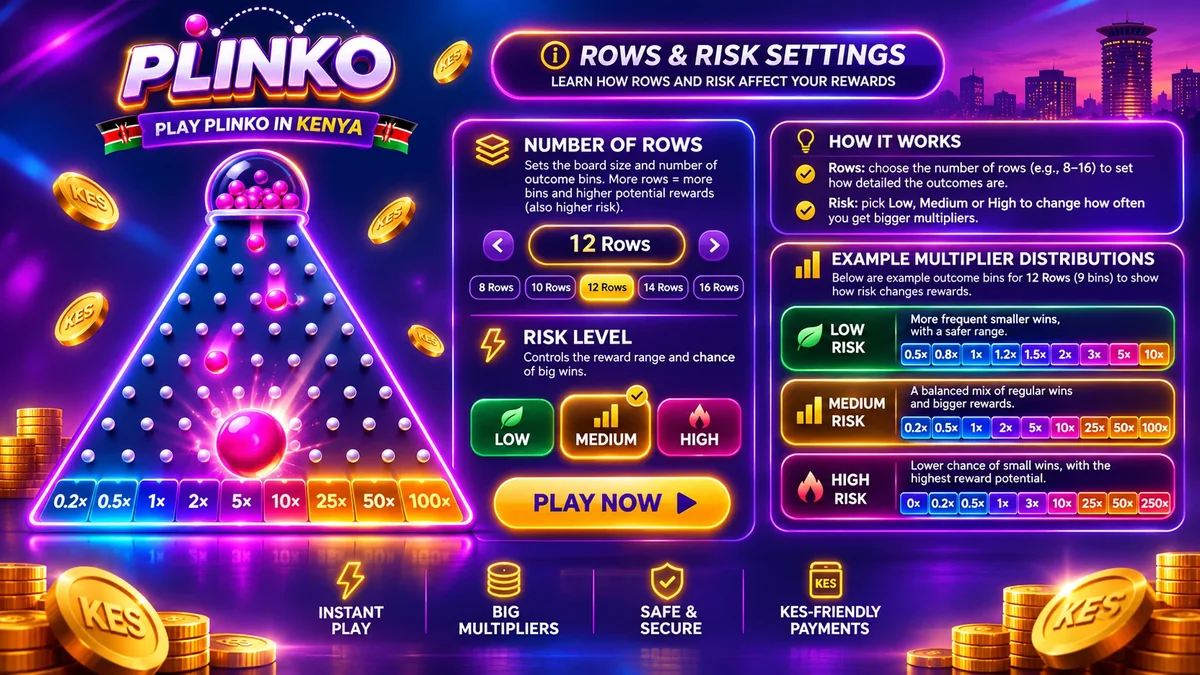
| Number of rows | No | More slots, wider range of multipliers |
| Risk level | No | Lower centre slots, higher edge slots |
| Auto against manual | No | Changes how fast the budget is spent |
| Choice of version | Yes, 97% to 99% | Each version has its own table |
Only the last row touches the long-run cost, and even there the gap is two points at most. The other rows shape the ride. They are useful for matching a session to your tolerance and useless for beating the game.
Budget rules in shillings
Fix the session budget before you open the game, and use an amount you can lose without touching rent, school fees or a loan. Say KES 1,000. Bet 1% to 2% of it, KES 10 to KES 20 a drop, so a bad stretch lasts long enough for you to notice it.
Write down two numbers. The stop-loss is the point where you quit, for example when KES 500 of the budget is gone. The stop-win is the balance at which you withdraw the profit and close the game, for example KES 1,500. A stop-win that you ignore is only a number.
The arithmetic explains why small bets matter. A high-risk centre slot pays x0.2, so a KES 50 drop in the middle returns KES 10. A run of such drops reaches a KES 500 loss in about twelve of them. Use the budget calculator to see your own numbers.
Open Plinko and keep the bet at the size you wrote down.
The board shows why patterns are an illusion
Drop 50 balls on 16 rows and the picture is a bell curve with a few outliers. The same exercise works in a game's demo. Drop 50 more and the shape returns, but the individual balls do not repeat. Each drop is independent of the last, whatever the previous ones did.
On an ideal 16-row board you expect about 20 centre hits and 17 hits on each neighbouring slot in 100 drops, which is our calculation. Three centre drops in a row happen about once in 130 attempts. That looks like a pattern and is routine.
The reverse thought is equally wrong. After ten middle drops the edge is not “due”. The board has no memory, and chasing an edge after a quiet stretch only raises the amount staked.
Methods that do not work, and why
| Method | Why it tempts | Why it fails |
|---|---|---|
| Doubling after each loss | One win should recover everything | Needs a double-or-nothing bet that Plinko does not offer, and limits stop it |
| Betting on edges after centre streaks | The edge looks overdue | Every drop is independent |
| Signals from a messaging group (see real or fake) | Someone seems to know | Nobody can see the seed, and the group can be a way to sell a casino link |
| Switching rows every few drops | A change might break the streak | RTP stays fixed, only the spread moves |
Take doubling in detail. Start at KES 20. After six losses in a row the stakes were 20, 40, 80, 160, 320 and 640, KES 1,260 in all, and the seventh bet is KES 1,280. It aims to win back a profit of KES 20. A single longer losing run ends the plan, because the next stake is beyond the balance or the table limit.
Choosing risk by how much losing you can stand
Low risk keeps multipliers close together, so the balance changes in small steps. High risk pushes the centre slots down to x0.2 and the edge up to x1000, which means long runs of small returns and, rarely, a spike. On an ideal 16-row board a given edge is reached about 0.15% of the time over 100 drops, so for a session of that length plan as if it will not happen.
Match risk to the length of the session. If you are playing 25 drops and want the balance to stay readable, a narrow setting fits. Choosing high risk is a choice to accept dull stretches. It is not an attempt to improve the odds.
Decide the rules first
Play with a budget, a bet size and a stop point
Write the three numbers down, then open the game. 18+ only.
Stop-loss and stop-win in practice
Limits only work when they are set before play and honoured after a loss. A deposit bonus works against them, because wagering terms keep you betting past the point where you meant to stop. After you hit the stop-loss, close the game for the day. Do not deposit again to “win it back”, and do not add a second budget the same evening.