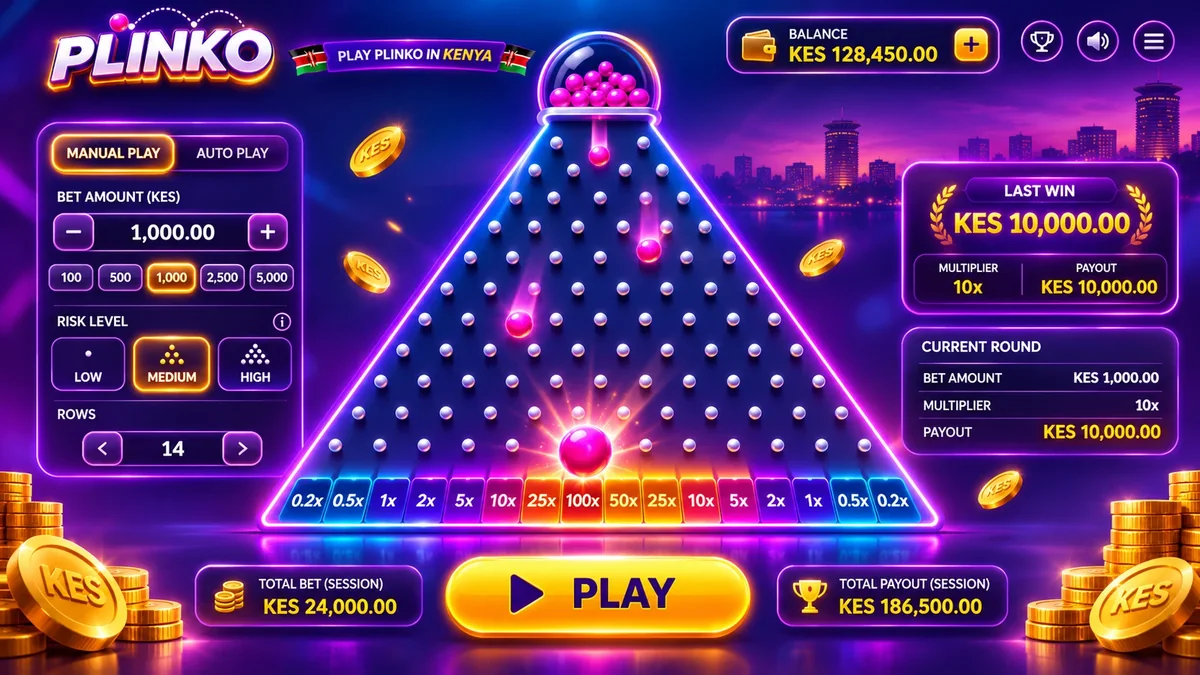
Learning how to play Plinko takes a minute: you set a bet, a number of rows and a risk level, and drop a ball that lands in a slot with a multiplier. The payout is your bet times that multiplier. Choosing settings is the only skill involved, because the landing slot is decided by chance.
Six actions in every drop
Check the version
Open the info screen and note the provider and RTP. A game named Plinko can be one of dozens.
Set the bet
Type an amount in KES. A bet that is 1% to 2% of your session budget keeps a losing run survivable: KES 10 to KES 20 on a KES 1,000 budget.
Choose the rows
BGaming and Stake boards offer 8 to 16 rows. Spribe offers 12, 14 or 16. More rows mean more slots and a wider spread.
Choose the risk
Low, medium or high on most boards. In Spribe's version you pick a ball colour instead.
Press drop
The ball falls through the pegs and lands in a slot. The slot was settled by the generator before the animation ran.
Read the result
Payout equals bet times multiplier. A multiplier under x1 returns only part of the bet, so the drop counts as a loss.
Rows and risk, level by level
Rows set how many slots there are. Risk sets how far apart their multipliers sit. The figures below are the 16-row ranges of the classic BGaming board, where the centre is the cheapest slot and the edge the dearest.
Edge x16, centre x0.5. A KES 50 drop in the middle returns KES 25, and one at the edge returns KES 800. The spread is the narrowest of the three, so a balance moves in smaller steps.
Edge x110, centre x0.3. The same KES 50 gives KES 15 in the middle and KES 5,500 at the edge. Medium suits players who accept longer quiet stretches in return for a higher ceiling.
Edge x1000, centre x0.2. KES 50 returns KES 10 in the middle and KES 50,000 at the edge. Most drops land in the cheap centre, and the x1000 slot is hit about once in 65,536 drops on an ideal board, our calculation.
Spribe's board does not use these names. Its 16-row table is listed in a different range, so apply none of these numbers to it. The RTP page shows both.
Open the game's demo and switch risk between drops.
A KES 50 drop on 16 rows, in numbers
| Risk | Centre slot pays | You receive | Edge slot pays | You receive |
|---|---|---|---|---|
| Low | x0.5 | KES 25 | x16 | KES 800 |
| Medium | x0.3 | KES 15 | x110 | KES 5,500 |
| High | x0.2 | KES 10 | x1000 | KES 50,000 |
The centre loses KES 25, KES 35 or KES 40 of the KES 50 and takes about one drop in five on an ideal board. We have no confirmed table for the 14 slots between the centre and the two edges, so check them in the game before you set the bet.
Plan the session before the first drop
Try KES 500 at KES 20: the calculator gives 25 drops, about six minutes. That tells you what a bet size really buys. A bet of KES 100 turns the same budget into five drops.
Manual or auto
Manual mode drops one ball per press, which gives you time to stop. Auto mode drops a series of balls with the settings you picked, and it removes the pause where most people decide to quit. If you use it, start with a short series and a stop-loss, and never raise the bet inside the series.
Controls first
Practise the six actions without a deposit
Run the same bet, rows and risk steps in a demo, then move on. 18+ only.