
RTP, return to player, is the share of all money staked that a game pays back over a very large number of rounds. Plinko RTP runs from 97% to 99%, and the figure belongs to the version, not to the name. A 99% game keeps KES 1 of every KES 100 and says nothing about your next ten drops.
RTP by version, and how solid each figure is
| Game | RTP | Basis of the figure | Top multiplier |
|---|---|---|---|
| BGaming Plinko | 99% | Provider's own game page | x1000 |
| BGaming Plinko XY | 98.91% to 99.16% | One catalogue; another says 99% | x1000 |
| Spribe Plinko | 97% | Two catalogues, provider page unreadable for us | x555, one source |
| Smartsoft Plinko X | 98.5% | Two third-party sources | Not confirmed |
| Betsoft Plinko Rush | 96.27% | One catalogue | x888 |
| Stake Originals Plinko | No official figure | Reports say 99%, not published by Stake | x1000 at 16 rows, high |
Plinko XY is a BGaming title and shares the classic's multiplier tables. Betsoft's Plinko Rush is a separate game and sits lowest. Where a figure rests on a single catalogue, the cell says so, and where it is missing, the information screen of your game is the only answer.
What the RTP gap means in shillings
Say you stake KES 2,000 in total over an evening, in KES 50 drops. On a 99% game the expected loss is KES 20. On a 97% game it is KES 60. On Plinko X at 98.5% it is KES 30.
Those are averages. On any single evening you can finish KES 500 down or KES 1,500 up, because one multiplier can be larger than the whole margin. The RTP gap matters when you play thousands of drops. In one session the choice of risk level moves your balance far more than the choice between 97% and 99%.
Rows and risk: what the multiplier ranges show
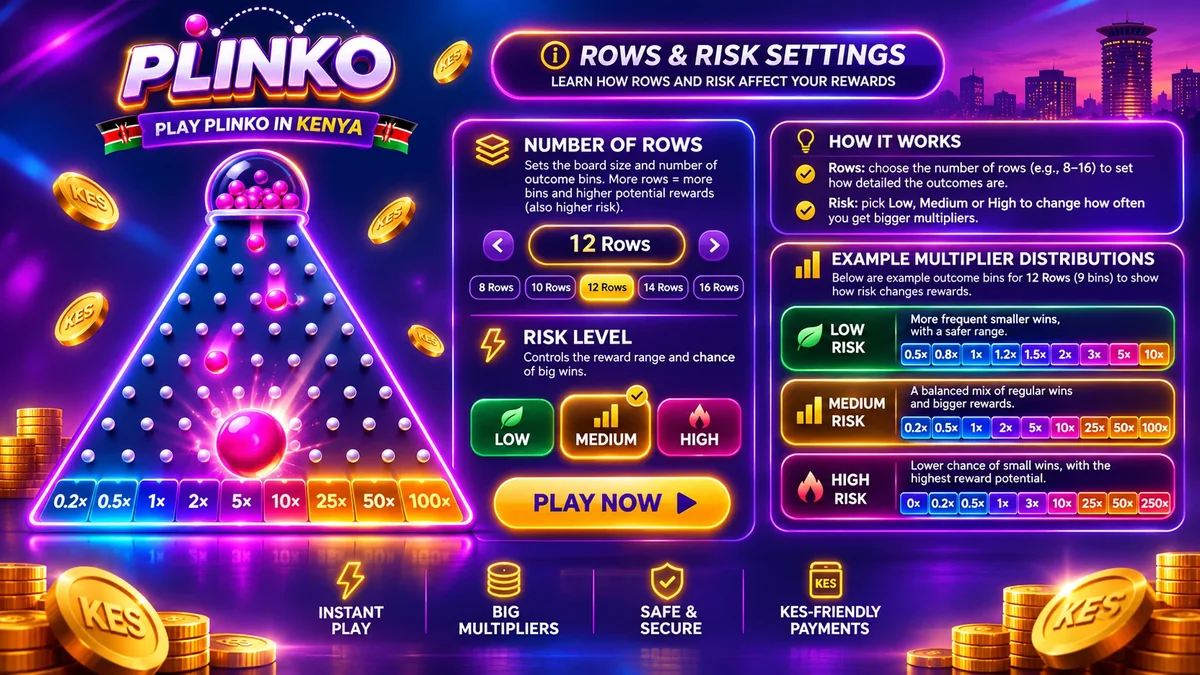
Rows and risk change the spread of the multipliers, not the RTP. The table gives the lowest and highest slot of the classic BGaming board, which Stake's board matches at 16 rows. Spribe uses ball colours and its own table, so these ranges do not apply to it.
| Risk | 8 rows | 12 rows | 16 rows |
|---|---|---|---|
| Low | x0.5 to x5.6 | x0.5 to x10 | x0.5 to x16 |
| Medium (Normal) | x0.4 to x13 | x0.3 to x33 | x0.3 to x110 |
| High | x0.2 to x29 | x0.2 to x170 | x0.2 to x1000 |
Read it from the left column. At low risk the best slot on 16 rows pays x16 and the worst x0.5. At high risk the best slot pays x1000 and the worst x0.2, which on KES 100 is KES 20 back. Row counts the table skips behave oddly: at low risk 14 rows top out at x7.1, below the x10 of 12 rows, and 15 rows reach x15.
Check it in the game
Compare this table with the one in your game
Open the info screen, note provider and RTP, then compare the multiplier ranges with the ones above. 18+ only.
Where the ball lands: our calculation for an ideal board
On an ideal board each peg is a fair left-or-right choice, so the chance of slot k on 16 rows is C(16,k) divided by 65,536. This is our calculation, not a provider figure. Real games decide each drop with their own generator.
| Slots counted from the centre | Share of all drops |
|---|---|
| Centre slot only | 19.64% |
| Centre 3 slots | 54.55% |
| Centre 5 slots | 78.99% |
| Centre 7 slots | 92.32% |
| Centre 9 slots | 97.87% |
| Centre 11 slots | 99.58% |
| Both edge slots together | 0.003%, about 1 in 32,768 |
Eleven slots out of seventeen take almost every drop. Over 1,000 drops a chosen edge slot is hit at least once in about 1.5% of cases, and either edge in about 3%. Over 10,000 drops the numbers rise to about 14% and 26%, but 10,000 drops of KES 20 is KES 200,000 of stakes.
From multiplier to money
The payout is bet times multiplier, and the multiplier includes your stake. A slot below x1 returns part of the bet, which is why centre slots count as losses.
Figures we could not confirm
The slot-by-slot multipliers of the 17 slots differ between the third-party sites we compared, so we publish only the minimum and the maximum of each board. Take the full row from your game's demo. The same goes for Spribe's x555, Smartsoft's top multiplier and Stake's RTP.
A figure in a table is not a promise. Odds, tables and calculators help you size a bet. They do not predict a drop, and the strategy page explains why. To see the same boards in action, use the demo, or read how a drop is played first.
Open the game and read its own RTP before you place a bet.